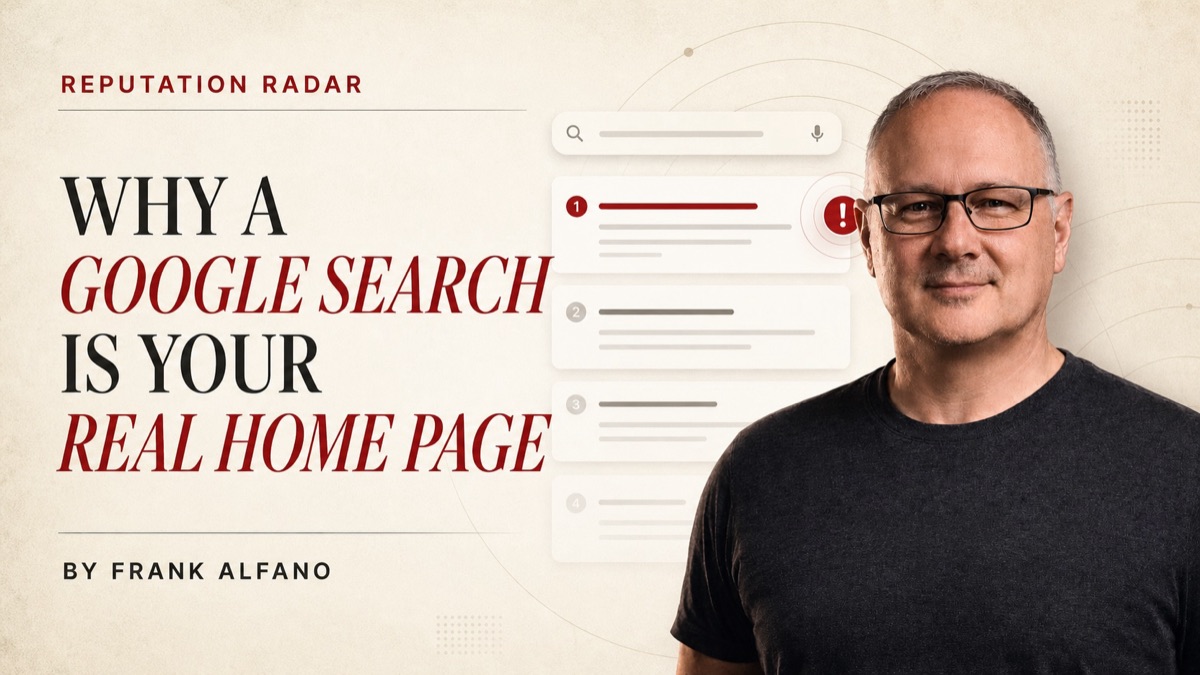
Why a Google search is your real homepage
You spent money on a website. Picked the colours, argued about the logo, wrote an About page you were proud of at 1 a.m. Most of the owners I talk to are surprised how few customers start there. Customers start by typing your business name into Google, and what shows up when you Google your business is the homepage they see. That first page is your reputation, whether you manage it or not.
I spent 33 years working in Ontario courtrooms as a paralegal before I started building websites and watching small business reputations for a living. Courtrooms teach you one thing fast: what people believe about you gets decided before you say a word, based on whatever is in front of them. Online, that's page one of a Google search. Ten or so results, a map panel, a star rating, and maybe a review snippet you've never read.
That page decides whether the phone rings.
The homepage you didn't build
Search your business name the way a customer would. Not logged in, on your phone, the exact words they'd use. What comes back usually looks like this:
- Your Google Business Profile, with a star rating you may not have looked at in months
- Two or three reviews Google chose to feature. Google chose, you didn't.
- Your website, somewhere in there
- Your social profiles, whether or not you've posted since 2023
- Directory listings with hours that may be wrong
- And sometimes a Reddit thread, a news item, or a one-star review with a long story attached
You wrote exactly one of those entries. You can claim two or three more. The rest is the homepage you didn't build. It gets edited daily by customers, competitors, algorithms and strangers, and it never asks for your approval before publishing.
A 4.2 rating with a fresh angry review at the top reads differently than a 4.2 with a warm review from last Tuesday. Same math, different first impression. When a prospect compares you to the shop across town, they are comparing page one against page one. If you'd rather have your page scored than squint at it yourself, that's what our free reputation audit does.
How to respond to negative reviews, and when not to
When something ugly shows up in your results, the first instinct is to fight it. I get the impulse. But after three decades around judges, the question I ask is the one a court would ask: is this fair comment, or is it a false statement of fact?
A customer who writes "waited 40 minutes, left annoyed" is entitled to say that. It stings, and it's fair comment. A post claiming you stole a deposit you never took is a different animal. One deserves a calm, professional reply. The other may be defamation, and that's a question for a lawyer. What I can tell you is which one you're looking at, fast, so you don't spend money on the wrong fight. Mixing those up is expensive in both directions. Owners burn money lawyering away honest criticism. And they leave defamation sitting on page one because someone told them nothing can be done.
No honest service can promise to delete Google reviews. Google removes reviews that break its policies, and rarely anything else. Anyone who guarantees removal is selling smoke. What works is knowing what's out there the day it appears, and stacking enough recent, genuine material that the old stuff slides off page one. Then responding the right way.
You can't respond to what you never saw
I don't say any of this from theory. I was a candidate for the bar when I took a public professional hit of my own, and I know what it's like when page one tells a version of your story you don't recognize. That experience taught me to separate the signal from the noise: which results matter, which ones don't, and which ones can be resolved. It's also why I built a service that reads the whole page instead of skimming the headline.
The owners who call me usually found the bad result weeks after it landed, when a customer mentioned it at the counter. By then every prospect who searched them had already read it.
That gap is what online reputation management is for, and monitoring is the first half of it. At Reputation Radar we watch your business name, and the names of the people behind it, across 11 sources: Google, Bing and Yandex search, Google Reviews, Reddit, the Better Business Bureau, Facebook, Instagram, X, YouTube, and news sites. The searches are exact-match and locked to your region, so a plumber in Hamilton doesn't get flooded with results about a plumber in Hamilton, New Zealand.
Every new result gets read, and I mean read. Our system pulls the actual page, works out whether you're the subject of the story or someone who left a comment on it, and rates the result for sentiment and severity on a 0-to-5 scale. A community crime post that a local professional merely commented on is nothing. A tool that only skims headlines would flag it as a crisis. Ours reads the page first.
When something negative and serious ranks, you get an alert the same day, with a plain-English verdict and a link. Not a monthly digest. The value of monitoring is time: hours instead of weeks to decide on a response while the situation is still small.
Every Monday you also get a report that answers the two questions you'd ask: what appeared, and what needs your attention. Two minutes to read, in plain English.
How to get more Google reviews without nagging anyone
If monitoring is defence, reviews are offence, and the lever that moves the whole page. A steady stream of recent Google reviews lifts your average and pushes stale negatives down, and Google reads recent reviews as evidence your business is still active. Recency counts. A wall of five-stars from 2022 tells a buyer you were good three years ago.
The businesses without that stream usually do fine work. They just never ask, because asking is awkward. So we made asking nearly automatic:
- A branded review link and QR code you can text to a customer or print on a counter card. One tap puts them on your Google review page.
- Email review requests that send themselves. Add a customer after a job, and they get a polite ask, then up to two gentle reminders over the following week. The moment they click, the reminders stop.
- We never filter by rating or steer only happy customers to Google. Every customer sees the same invitation, because gating reviews violates Google's policies and puts your listing at risk. Services that gate are gambling with your profile.
Put the QR card beside the debit machine. Put the link in your invoice email. That's the entire system. The reviews come in because the ask happens every time, instead of when someone remembers.
Put the proof where buyers are looking
Collecting reviews is half the job. Showing them is the other half. Your newest five-star reviews should be working on your own website, not buried three clicks deep in a Google profile. We're rolling out a social proof widget that displays your latest reviews on your own site automatically. Displaying your best reviews is marketing, and it's allowed. Filtering who gets asked in the first place is not, which is why we don't.
What to do this week, with or without us
Some homework that costs nothing:
- Google your business in a private browsing window, on your phone, using the words a customer would use. Read page one slowly. That's your real homepage.
- Claim and complete your Google Business Profile if you haven't. Hours and photos, at minimum. It's free and it anchors the whole page.
- Read your last ten reviews and reply to the ones you never answered, including the good ones. A reply signals a business that's paying attention.
- Ask your next three happy customers for a review, personally. Say the word Google. Then notice how many you'd have asked if a system had done it for you.
If you'd rather know exactly where you stand before you touch anything, run our free reputation audit. It scans Google for your business and the people behind it, rates every result, and emails you a scored report. Free, once a month, no strings. If we find something serious, we'll tell you privately and talk it through instead of dropping it in a PDF. We're based in Hamilton, Ontario, and we built the whole service for Canadian small businesses. Monitoring starts at $49 CAD a month if you want us watching for you.
Quick answers
Can you delete a bad Google review?
No, and be wary of anyone who says yes. Google removes reviews that violate its policies, and rarely anything else. The honest play is a professional response plus enough recent positive material that the old review stops being the first thing people see.
How do I get more Google reviews?
Ask every time, and make the ask one tap. A review link or QR code at the point of payment, plus a follow-up email after the job, beats good intentions. Keep it honest: the same invitation goes to every customer, with no filtering by rating.
What is online reputation management?
Watching what shows up when someone searches your business, and building the reviews and content that shape that page. The monitoring half tells you what's out there the day it appears. The building half gives searchers something better to find. Reputation Radar does both, from $49 CAD a month.
Your website is the homepage you wrote. Page one is the homepage your customers read. We watch it so you hear about problems first. We help you earn the reviews that reshape it. And when a post crosses from criticism into something for a lawyer, you'll hear that straight, from someone who spent 33 years watching where that line sits.
Frank Alfano is the founder of Reputation Radar. He spent 33 years as a paralegal in Ontario courtrooms and holds an LL.B. (Hons) from the University of London and an LL.M. (Hons) from Osgoode Hall Law School. Reputation Radar monitors business reputations across 11 sources, from $49 CAD a month. Start with the free audit.
Find out what Google says about you.
The free reputation audit scans Google for your business and the people behind it, rates every result, and emails you a scored report. Free, once a month, no strings.